 Issue 23 - 2026
 Issue 22 - 2026
 Issue 21 - 2026
 Issue 20 - 2025
 Issue 19 - 2025
 Issue 18 - 2025
 Issue 17 - 2025
 Issue 16 - 2025
 Issue 15 - 2024
 Issue 14 - 2024
 Issue 13 - 2024
 Issue 12 - 2024
 Issue 11 - 2024
 Issue 10 - 2024
 Issue 9 - 2023
 Issue 8 - 2023
 Issue 7 - 2023
 Issue 6 - 2023
 Issue 5 - 2023
Medieval World: Culture & Conflict picks up where its sister magazines – Ancient Warfare and Ancient History – leave off. The publication features the rich history and material culture of the Middle Ages – broadly conceived geographically and temporally – expanding on the contents of the popular Medieval Warfare magazine. Through well-researched and lavishly illustrated articles, this accessible publication brings to light cultural activities in local and global contexts, historical figures and events, as well as political, religious, economic, and artistic facets of the Middle Ages..
Medieval World Culture & Conflict Magazine
Editorial
Medieval history news and recent discoveries MARGINALIA
ON THE COVER
A legendary city of knowledge BAGHDAD • Founded in the mid-eighth century as the new capital of the Abbasid Caliphate, Baghdad swiftly became one of the great cities of the medieval world. The city’s rulers, locals, and many visitors helped create a reputation for scholarship, architecture, and a refined lifestyle that drew on the many cultural and religious traditions of Afro-Eurasia. By the tenth century, it had already achieved legendary status and, ever since, has been held up as one of the great centres of civilization.
Rivals to Bagdad: CÓRDOBA
Rivals to Bagdad: SAMARRA
Rivals to Bagdad: RAQQA
Medieval China’s imperial enforcers THE JINYIWEI • The Ming Dynasty (1368-1644) was a period of recovery from Mongol rule. It was marked by cultural rebirth and innovation, the creation of one of the world’s largest and strongest armies, and the establishment of a vast centralized government that answered to one autocratic ruler—the Ming emperor.
Embroidered uniforms
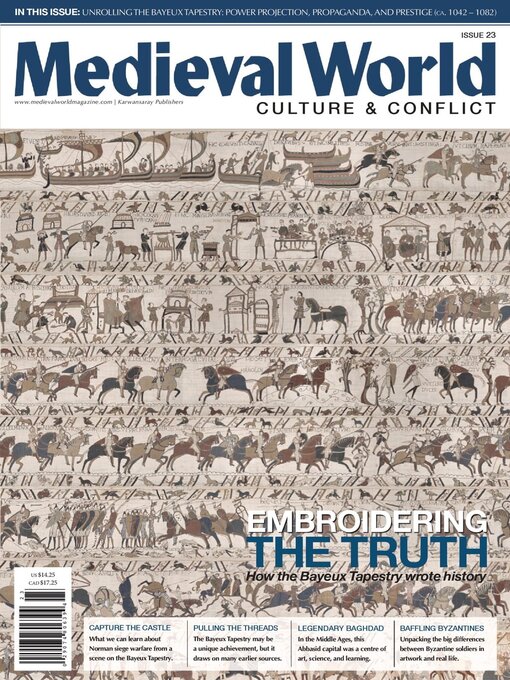
Introducing the Bayeux Tapestry THE THREAD OF HISTORY • The nearly 70-metre-long Bayeux Tapestry is one of the most famous historical arte-facts in the world. It tells the persuasive, albeit one-sided, story of the conquest of England by William, Duke of Normandy, who would go on to found the House of Normandy, which ruled England until 1135. Yet, there is much unknown about the tapestry, including who made it and why.
Colourful embroidery
An arrow to the eye
Why textiles mattered in the Middle Ages THE FABRIC OF SOCIETY • Once you start to pull at the thread of medieval societies, it’s impossible to avoid the centrality of textiles. From trade to warfare, fashion to survival, prestige to practicality — this world was draped in fabric, literally and metaphorically. Whoever commissioned the Bayeux Tapestry was making a statement in more ways than one.
Norman siege warfare on the Bayeux Tapestry EMBROIDERED PROPAGANDA • Scene 19 of the Bayeux Tapestry occupies a pivotal position within both the narrative structure of the embroidery and the broader ideological programme that underpins it. Far more than a simple illustration of a military episode, the scene offers a carefully constructed representation of Norman power, combining themes of conquest, cavalry warfare, lordship, and political legitimacy.
Sources and references for the Bayeux Tapestry DESIGNING A MASTERPIECE • At 68 metres, the Bayeux Tapestry is not only the largest surviving medieval textile, it is the largest non-architectural medieval artefact in existence. The Tapestry shows events leading up to the Norman Conquest of England, with the penultimate surviving scene showing the death of King Harold II, the last Anglo-Saxon king.
Rulership on the Bayeux Tapestry CONSPICUOUS CORONATIONS • At the time of writing, the Bayeux Tapestry has returned to England — if indeed it was created there — for the first time in a millennium. If you get a chance during its residence at the British Museum to have a good long look, you will find that one scene is conspicuously absent: the coronation of William I ‘the...